1. High-Rise Balcony Architecture in Modern Kochi
Residential developments across Kochi have trended toward open, airy architectural styles. Balconies frequently incorporate minimalist horizontal railings, glass balustrades, or ornamental steel rods. While visually pleasing, horizontal railings can function as ladder rungs for inquisitive toddlers, and wide gaps beneath glass panels or between vertical bars can allow small pets or personal items to slide through.
High-rise developments in areas such as Marine Drive, Chilavannoor, and Kakkanad often sit 15 to 30 floors above ground level. At these heights, strong wind drafts are common, and the psychological anxiety associated with open balcony boundaries is heightened. Professional balcony netting transforms these open spaces into secure, functional zones where families can relax with greater peace of mind.
2. Understanding the Protective Role of Balcony Safety Nets
It is essential to understand the functional definition of safety netting:
- Supplemental Barrier: Netting can provide an additional protective barrier against accidental falls and drops. It acts as an elastic containment envelope that absorbs physical impacts.
- Responsible Safety Mindset: Safety netting is an engineered precaution; it should never be treated as an excuse to leave young children or pets unattended on elevated balconies. Responsible adult presence remains the foundational rule of high-rise safety.
- Non-Confining Design: Unlike heavy iron grills that feel cage-like and block fire exit routes, safety nets maintain a sense of openness and can be dismantled swiftly during emergencies by rescue personnel.
3. Child Safety Considerations: Creating an Additional Protective Layer
Toddlers are naturally curious, agile, and unaware of high-elevation dangers. Common balcony hazards include:
- Pushing chairs or storage boxes toward handrails to climb up and peek over.
- Squeezing through railing balusters that exceed 4 to 6 inches in width.
- Leaning outwards to watch traffic or flying birds.
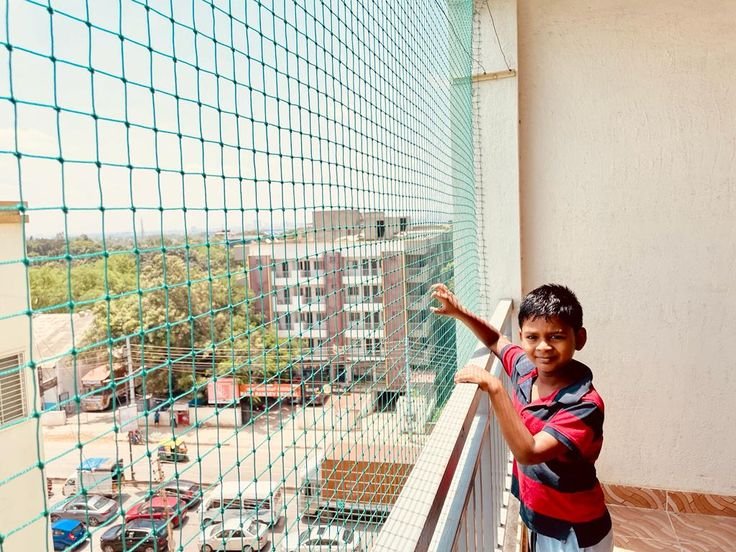
A tightly tensioned, heavy-gauge nylon or HDPE net installed from handrail to ceiling—or across the entire floor-to-ceiling opening—creates a resilient physical boundary that blocks climbing attempts and prevents small bodies from slipping through railing gaps.
4. Pet Protection: Securing Inquisitive Cats and Dogs
Cats possess an instinct to track birds and insects, often leaping onto narrow handrails where a loss of footing can prove fatal. Similarly, energetic dogs frequently lean against railings, excited by street noises below. Dedicated pet safety netting utilizes a tighter mesh aperture (typically 25 mm to 40 mm) woven from multi-strand, bite-resistant twine. This prevents cats from slipping their heads through and withstands scratching, ensuring that balconies remain welcoming, pet-friendly outdoor zones.
5. Preventing Accidental Falling Objects from Elevated Floors
In dense high-rise housing societies, falling objects present substantial legal, financial, and physical liability. Potted plants, laundry pegs, toys, mobile phones, and cleaning tools can be accidentally kicked or dropped off balconies. From the 10th or 20th floor, even a lightweight toy or plastic cup can cause severe injury or property damage to pedestrians and parked cars below. Enclosing balconies with protective netting ensures that dropped objects remain contained inside the balcony perimeter, fostering a safer community environment.
6. Material Integrity: High-Tensile Nylon vs. Polyethylene
Balcony safety netting requires significantly higher breaking strengths than standard bird netting:
Heat-Set Knotted Nylon
Superior energy absorption and tensile elasticity. Stretches slightly under sudden force, dissipating impact shock safely without tearing. Ideal for child and pet barriers.
UV-Stabilized HDPE
Non-absorbent, dimensionally rigid, and highly resistant to rot, mildew, and coastal salt humidity. Excellent for homes facing direct seaward exposure.
Certified Twine Gauge
Typically 1.5 mm, 2.0 mm, or 2.5 mm braided twine with certified breaking strengths ranging from 50 kg to 150 kg per individual mesh cord.
7. Non-Obstructive Engineering: Preserving Views and Ventilation
Homeowners often hesitate to install balcony barriers, fearing their scenic view will be ruined. Modern safety nets are engineered to minimize visual disruption. Translucent mono-filament and charcoal-black nets offer remarkable visual transparency. Black nets absorb sunlight rather than reflecting it, blending into the background so your view of Kochi's backwaters or greenery remains crisp and clear. The open-grid geometry allows coastal sea breezes to circulate unimpeded, keeping interiors cool and ventilated.
8. Reliable Anchoring and Perimeter Tensioning Techniques
A safety net is only as dependable as the boundary anchoring that holds it in place:
- Concrete Anchors: Technicians drill high-precision holes into structural concrete ceiling beams, side pillars, and parapet walls at intervals of 1 to 1.5 feet.
- Marine-Grade Hardware: High-grade nylon rawl plugs coupled with stainless steel (SS 304) screw hooks prevent rust formation that could weaken anchors or stain exterior paint.
- Boundary Cable Integration: A PVC-jacketed stainless steel wire rope is threaded through all perimeter eyelets, tensioned securely with heavy-duty turnbuckles to create an unyielding perimeter frame.
- Uniform Net Attachment: The net is interlaced and crimped onto the perimeter cable with stainless-steel hog rings, ensuring tension is distributed evenly across the entire surface without loose sag spots.
9. Cost Considerations for Balcony Safety Net Installations
Balcony safety net pricing in Kochi is determined transparently based on project specifications:
- Balcony Dimensions: Total square footage calculated from width and height measurements.
- Material Gauge & Grade: Heavier 2.5 mm high-tensile nylon nets are priced moderately higher than lighter 1.0 mm bird nets due to polymer mass and tensile rating.
- Mounting Architecture: Straight rectangular balconies require standard anchoring; curved, cantilevered, or stepped balconies require extra hardware and custom fabrication.
- Accessibility & Rigging: Standard interior access requires less setup than upper-floor installations that require external safety harness suspension.