1. Why Professional Net Installation Matters
A safety net is a tension-dependent system. If the perimeter boundary is insecure or tension is distributed unevenly, the netting material cannot perform to its design specifications. Professional rigging ensures lateral forces (from wind, bird pressure, or accidental contact) are dispersed uniformly across multiple anchor points rather than pulling on a single weak screw.
A professionally fitted net hangs completely flat and taut, with aligned square mesh rows that blend seamlessly into building architecture. Sagging, wrinkled nets look unsightly and detract from property value. Certified technicians understand structural concrete, brick masonry, and hollow blocks, selecting the correct anchor depth and plug type to prevent masonry cracking.
2. The Risk of DIY and Substandard Fixing Methods
Many homeowners attempt DIY fixes using over-the-counter netting and plastic stick-on hooks:
- Adhesive Failure: Kochi’s intense humidity, direct sun, and monsoon moisture dissolve chemical adhesives within months, causing nets to detach suddenly.
- Dangerous Working Conditions: Leaning out of high-rise apartment windows or reaching over 15th-floor balconies without professional fall-arrest harnesses presents severe safety risks.
- Pigeon Ingress Through Gaps: Inexperienced installers frequently leave 2-to-3-inch gaps around corners and drainpipes, which pigeons exploit immediately to establish nests behind the net.
3. Stage 1 & 2: Initial Consultation and Laser Site Survey
The installation workflow begins with a structured discovery process:
- Identifying Primary Objective: Determining whether the customer requires bird exclusion, child protection, pet containment, duct area sealing, or industrial safety.
- Laser Measurement: Recording precise perimeter dimensions—width, height, arch contours, and ceiling angles.
- Substrate Inspection: Assessing masonry composition (cured RCC slab, solid brick, plastered masonry, or metallic framing) to choose appropriate drill bits and anchors.
- Obstacle Mapping: Documenting utility pipes, satellite cables, outdoor air conditioner brackets, and lighting fixtures to plan neat pass-through detailing.
4. Stage 3 & 4: Material Specification and Structural Anchoring
Technicians establish a rigid perimeter framework around the entire opening:
- Material Customization: Specifying UV-treated virgin HDPE (for weather endurance) or high-tensile heat-set braided nylon (for child and pet safety).
- Precision Drilling: Drilling 6 mm to 8 mm pilot holes at strict intervals of 12 to 18 inches along concrete walls, ceiling slabs, and parapet coping.
- Anchor Hardware: Inserting heavy-duty nylon rawl sleeves and screwing in corrosion-resistant stainless-steel (SS 304/SS 316) anchor hooks.
- Wire Rope Rigging: Threading a multi-strand, PVC-coated stainless steel boundary cable through the anchor hooks and tensioning it with turnbuckles.
5. Stage 5 & 6: Net Attachment, Uniform Tensioning, and Quality Sign-Off
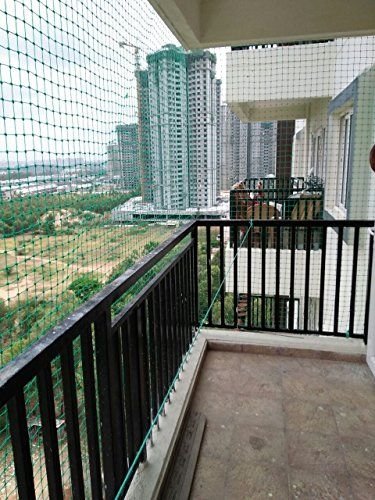
With the boundary framework established, the netting is installed:
- Row-by-Row Interlacing: Technicians hang the netting from the top corner, aligning mesh rows horizontally and vertically.
- Mechanical Fastening: Fastening each border mesh square to the tensioned cable using industrial stainless steel rings or UV-stabilized heavy-duty fasteners every 3 to 4 inches.
- Edge Trimming: Carefully trimming excess border netting with heated shears to prevent twine fraying, leaving a clean, straight edge.
- Tension Verification & Cleanliness: Testing boundary cable tension and corner anchor stability, followed by thorough cleanup of drilling dust and shavings.
6. High-Rise Safety Standards and Abseiling Capabilities
Installing netting across exterior building ducts, central shafts, and elevated balconies requires specialized safety equipment:
- Fall-Arrest Systems: Installers use full-body industrial harnesses anchored to structural anchor points inside the apartment.
- Certified Rope Access (Abseiling): For inaccessible exterior utility shafts in commercial towers and large residential communities, certified rope-access technicians abseil down building exteriors to install full-height netting safely.
- Insurance and Safety Compliance: Technicians operate under strict safety protocols, ensuring zero hazard to building occupants or pedestrians below.